
Nuturing a Greener Future: The Sustainability of Wood Flooring
Save this blog post for later!
With growing concerns over the wellbeing of the environment amidst the rise of climate change, looking into the background of all materials in order to make an eco-friendly decision can be helpful. In this blog post, we are diving into arguably the most sustainable option: traditional sand & finish hardwood.
Going forward, hardwood will refer to site-finished solid hardwood, where each plank is a solid piece of wood. The planks themselves have had minimal to no manipulation from the wood mill, where the wood planks themselves are fresh from the milling and drying process with nothing else going on with the plank. Other hardwood options include engineered wood, which can be prefinished in a factory or site finished. Usually, engineered wood floors are not solid planks of wood, which means there are more factors that go into the sustainability of this specific type of wood flooring. Engineered wood floors deserve its own article exploring the different sustainability factors and impacts flooring shoppers should be aware of.
Regardless of what type of wood floor we are looking at, since each type of wood floor is made with one of the most renewable resources available on the planet, wood floors will be highly sustainable and will more than likely always be more sustainable than other flooring options, like wool carpet and stone floors. Trees can replace another tree that has been farmed for various uses like paper, fuel, and standard wood products, and if done correctly, sections of forests that are dedicated to a mill will be better for the environment—no deforestation on a massive scale, while also creating an actual benefit for the ecosystems dwelling in farming forests. Similar things can be said with other flooring options, like again, wool carpet specifically, but typically, wood floors provide more benefit in the long run for the homeowner and for the planet itself. Now, that may not always be the case, but in a majority of instances, wood will be the best option for the environment. Why is that?
Harvesting and the Mill
For most hardwood products, the carbon footprint prior to installation is extremely minimal, and depending on the post-installation finish, the impact may actually be further mitigated. According to various studies comprised by the National Wood Flooring Association, which is an international for-non-profit association that sets standards and provides information for all aspects of wood flooring across various groups and individuals that relate to the wood flooring trade to any degree, “hardwood used to make flooring is [in fact] harvested sustainably in the United States[, with] net annual growth in… hardwood forests exceed[ing] harvest and mortality by 33% each year” (p. 5). Wood used for hardwood flooring, therefore, is highly sustainable because trees used to create the planks themselves are replaced faster than they are harvested. Consequently, the footprint of harvesting the wood for the planks themselves is negated by the fact there are more trees taking the place of the one lost. With more plants and forests ready to naturally scrub clean our air, produce food, and provide a natural habitat, the healthier the planet can be.
As for the habitat the trees themselves play a role in, timbering can actually further benefit forest ecosystems if done in a sustainable manner, rather than clearing out entire groves and wooded areas at one time. Forests naturally have trees significantly taller than other trees and plants in an area, thus creating a canopy over the top of the forest; the canopy then filters and blocks light from reaching lower levels of the forest, meaning vegetation on the ground may not be as bountiful for ground wildlife. Sustainable timbering, however, can prevent major ecosystem changes and allow the life already living within the wooden lands to thrive, thus helping the overall health of the ecosystem. Catawba Lands Conservancy (CLC), a nonprofit, community-based conservation organization in North Carolina, best describes the benefits of timbering as follows:
“Cutting down canopy trees... increases sunlight at the forest floor and encourages more ground vegetation to grow. This vegetation is especially beneficial to wildlife that browse this new tender growth, supports more flowers and fruits. [For instance,] White-tailed deer and other browsing species eat this new tender vegetation. Many native ground-nesting bird species like the American Woodcock, Wild Turkey, Easter Meadowlark, and Northern Bobwhite find shelter and insects to eat in these now open spaces”
With more vegetation options, the healthier the ecosystem can be. More foods for wildlife to eat can help the species thrive in the area, which can therefore benefit other species within the ecosystem. Deer numbers rise, therefore a healthier wolf pack. The cascade continues to other sections of an ecosystem, which improves the quality of life for the entire system–even the wood harvested can have benefits due to the increased sunlight, more animals able to eat pests, and more carcasses able to decay and return nutrients back to the ground.
However, this is the best case scenario. There are a multitude of forests that are properly timbered and can actually offer these benefits to the local ecosystem, but there are a multitude of forests that do not replace trees either fast enough to replenish the forest, take out too much that puts the ecosystem at risk for other environmental dangers like forest fires, or straight up destroy an entire forest itself for agriculture, housing, or company-use. In these instances, the sustainability of wood comes into question.
A properly timbered forest actually aims to keep the oldest growth for a variety of reasons. The oldest trees have the largest carbon dioxide storages both within the tree itself and within the root system underground, and the older trees are able to capture more carbon dioxide in the first place due to their size and age. In fact, the harvest old growth trees is the 2nd leading source of carbon dioxide emissions, behind the burning of fossil fuels. Despite being second, it is important to note that fossil fuels account for 87% of carbon emissions, whereas land-use, which accounts for deforestation and agriculture, only accounts for 9%, according to a study done in 2013 (Le Quéré, C. et al.) Being a leading cause of carbon dioxide emissions is something we should take into account when examining the sustainability of hardwood flooring, but compared to fossil fuels, deforestation is rather minimal. Still, the effects of deforestation should still be something we take seriously and is something we should work on as a global community.
The carbon dioxide release also affects distant ecosystems. Being the second highest form of carbon dioxide emissions, the harvest of old growth forests simply moves the stored carbon dioxide to another location, and what’s going to be more likely to absorb that much carbon? Oceans. Since oceans cover around 75% of the globe, water is more likely to absorb the carbon dioxide than other forests, which do not have near the same amount of surface area. If carbon dioxide rates in the ocean rise, that means the salts naturally found in the water are going to have more material to bind to and cause a chemical reaction. The resulting chemical reaction creates carbonic acid, which lowers the pH of the surrounding area. With enough carbonic acid, the overall pH can lower enough to cause certain compounds like carbonate fail to form. Shellfish and other crustaceans, as well as coral reefs, use carbonate to form their shells, exoskeletons, and overall structure; the decrease in carbonate causes the ecosystem to fight over resources, leading to the overall integrity of the system to crumble and eventually die.
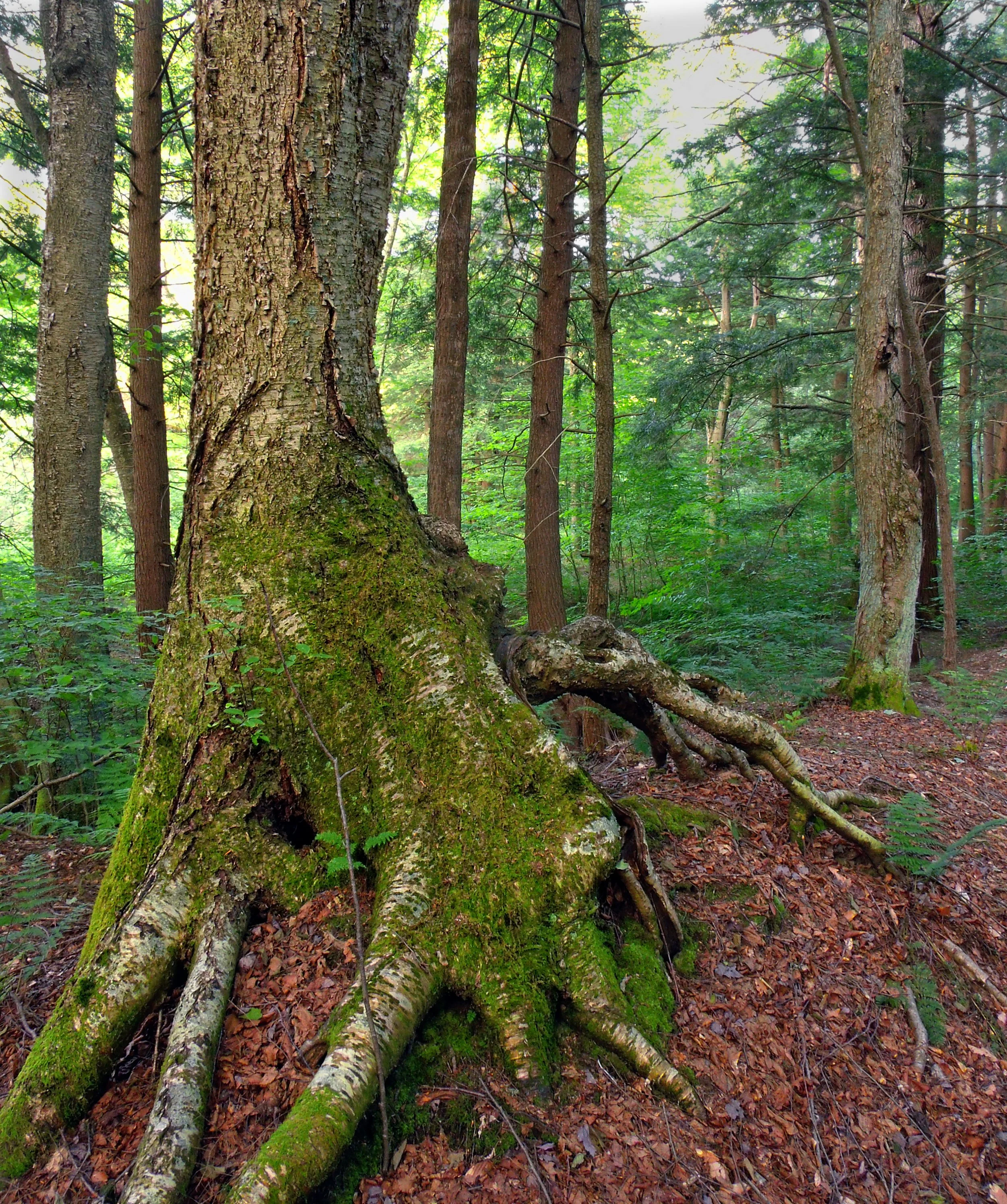
Furthermore, forests are more likely to face degradation if enough trees—and specifically older trees—over time, which is the loss or shrinking of an area’s ecosystem. With less old growth, the ecosystem is put at greater risk—and that heavily affects us. For starters, communities around the globe rely on food and medicines that come from a natural forest. If these sources of food starts to deteriorate in quality, those communities face an increased risk of malnutrition. The degradation problem persists leads to these communities facing a food and health crisis, which can lead to entire communities being wiped out, either directly caused by the lack of nutrition and medical care or by the community itself packing up and immigrating elsewhere. That’s a problem that can be mitigated, which means that where forest degradation is currently affecting communities, their suffering directly related to this problem is something that should not be happening and can be stopped.
Old growth also protects our own communities from flooding. Typically, old growth trees are going to be massive and provide a strong canopy that slows down rainfall, thus allowing the soil to absorb water at a slower, steady rate instead of becoming oversaturated and therefore unable to absorb any more water. When water does absorb into the soil, the roots themselves can absorb the water, which again helps the soil from oversaturing. The roots also create clear channels for water to run through, meaning water can go deeper into the earth faster. Roots also stabilize the soil, and the stabilization prevents erosion and runoff, meaning nearby rivers can support a proper water flow over time; if too much soil runs off, the river’s depth can become more shallow, and where the sediment lands can create blockages and other disruptions to the river’s course. Trees can also naturally move water from the ground into the air through a process known as evapotranspiration. Evapotranspiration decreases the amount of water within the soil, so by the time the next rain storm comes along, the soil will be ready to reabsorb more water instead of letting standing, potentially flowing, water form from oversaturation. With all of these flood protections, the ecosystem itself has strong defenses from a natural disaster, and that trickles down to our own human-made communities. The forest therefore protects us from flooding, and depending on the natural river flow of the area, allows us to have access to clean, consistent water.
Wildfires also become less of an issue thanks to old growth. With their marvelous ability to take in water, the same reasons old forests defend against flooding are the same reasons wildfires are slower to spread if they can start in the first place. Evapotranspiration makes the air in the forest have a higher relative humidity, which increases the overall dampness of the environment and therefore make the climate less combustible. Mature trees will naturally have thicker bark, and that can help with a single tree’s defense against fire and fire-spread; younger trees will not have the same bark thickness and will be more likely to catch fire. The tall canopies of old growth forests make it harder for winds to reach the lower levels of the forest, making it harder for fire to spread quickly. As mentioned before, thicker canopies reduce the amount of ground vegetation, which means fires will have less material to catch and burn. Finally, the forest has had plenty of time for survival of the fittest to run its course over and over again, meaning any offspring the trees have had over its lifetime have had to compete with other offspring; the limited amount of sunlight that breaks through the canopy and water left from the older trees absorbing massive amounts of water will not be able to support multiple massive trees, meaning a handful will survive and make it to the next generation. This leads to more gaps between trees themselves, making the forest less dense unlike man-made timbering forests where the goal is to make dense forests for more wood. With more space between trees, the further fire has to travel to make it to the next fuel source, and the sources themselves are already rather tough to burn through.
With all of that said, timbering can be beneficial for an ecosystem and for human-kind if we are aware of what trees are safe to harvest. There’s a good ecological reason hardwood used in modern construction is not an older, sturdier timber, and while there are drawbacks to using younger wood, the environmental benefits heavily outweigh the drawbacks. If you are looking to install new hardwood floors, look into what mills are sustainable and how their practices qualify them as sustainable. Doing so can also lead to you finding out a unique story that comes from the forest your floor originated, which can build so much life and character into your home. Wood can carry memories, so to know its own life can make your home that much more charming. The only major drawback that comes from researching mills is the wood species selection itself. For instance, if you are looking to get a Brazilian Cherry wood installed, finding a mill that is sustainable will be more difficult than finding a mill that offers local oak, maple, and hickory varieties. The transportation cost of shipping Brazilian Cherry from the Amazons will also be higher than local timber mills, and naturally, more fossil fuels will be burned trying to get the wood to your home. The environmental cost and actual cost are rather high and should be taken into account. In situations like this, finding a Brazilian Cherry LVP that has the look you want will more than likely be more cost effective for both the global ecosystem and your budget. In situations like this, wood may not be the most sustainable option.
Installation, Sand, and Finish
Unlike other flooring methods, traditional site-finished hardwood flooring can be installed in numerous ways–floating, nail, staple, glue-assist, and glue-down. That means, depending on the subfloor, hardwood flooring can be installed without releasing any VOCs. Furthermore, with modern air filtration systems (HEPA), sawdust exposure is rather low; whatever sawdust that does appear is created during a portion of the cut that is rather difficult and at times impossible to capture, and even then, the dust is easy to remove by vacuuming all surfaces.
If the subfloor is concrete or other solid subfloors, then the hardwood will have to be glued-down, and VOCs will be released. However, there are eco-friendly hardwood companies that specialize in safe and low emission installation products, such as Bona and LOBA. Both of these companies have lower-than-average VOC emissions, while not sacrificing the quality of the glue. The smell and other gasses dissipate rather quickly and will not be noticeable after a couple of hours at most.
Moving to the next stage of a traditional site-finished hardwood, there are various wood fillers, stains, and finishes on the market that produce low VOCs. Regardless of the installation method and what is possible given the subfloor, a method that does not produce VOCs does not exist at this stage, unless the homeowner chooses to leave the hardwood unfinished and exposed. Leaving the wood exposed is not recommended, as the wood will naturally and quickly absorb any liquid and will stain.
However, going back to LOBA specifically, their products boast some of the leading products in low VOC emissions. LOBA stains have a dry time of an hour, regardless of the color, which is highly impressive given most other stains have a dry time of 2-12 hours on average, with some taking even longer and varied by color. Furthermore, all LOBA finishes to seal the wood hold various certifications across numerous European and Asian countries that have some of the strictest low-VOC standards, such as Singapore Green Label. In other words, depending on the type of finish a floor needs in order to withstand whatever comes its way, LOBA products have a low odor that dissipates quickly upon application, and the gases that are emitted from the product are extremely low and safe to breathe compared to other finish products on the market. Now, that isn’t to say PPE gear is not recommended when using, as there can be individual risks towards the gases that are released for some individuals. From a pure environmental and average human health perspective, LOBA is one of the safest, if not the safest, product on the market.
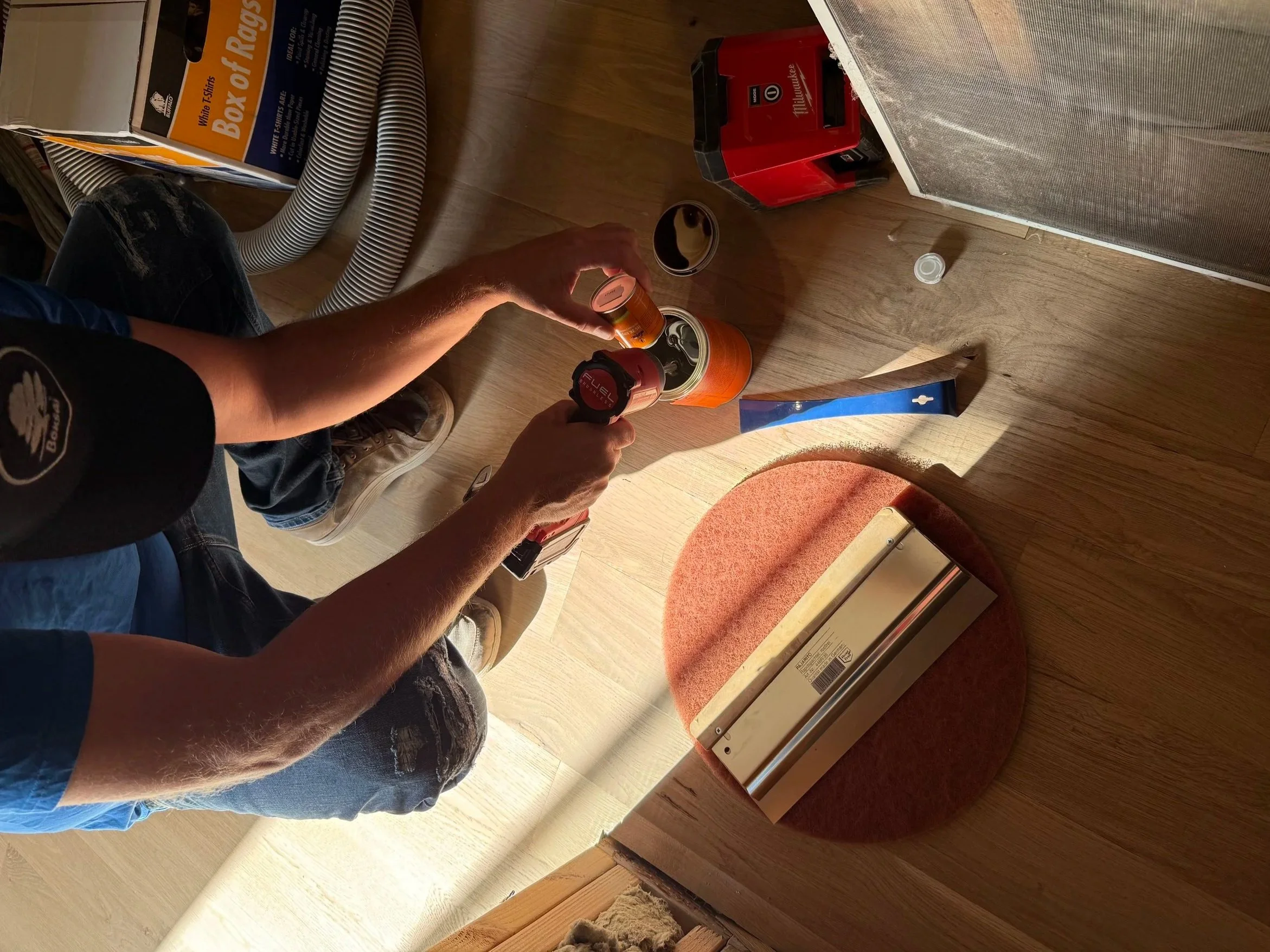
Preparing a stain mix to apply to a freshly sanded hardwood floor.
Maintenance and Lifecycle
Post-finish care varies based on the finish manufacturer’s recommendations, but we are going to take the average recommendations that are extremely likely to be shared across the board between all manufacturers. Most finishes require a neutral pH cleaner, so think of water: a substance that is not acidic or basic. Check out our article on cleaning planked flooring for information as to why a pH cleaner is highly recommended here. Ignoring the benefits of using a pH neutral cleaner for floor maintenance, a neutral option is less likely to harm you while using it, and in turn will cause less problems for the environment. Now, using environmentally-friendly cleaners does not mean the cleaner has to be absent of any chemicals. Chemicals are naturally found in the world around us and are what allow our bodies to function. Depending on the chemical composition, certain substances can have multiple uses and behave a different way depending on the context, which is why certain chemicals are safe in specific environments and risky in others. With that said, using chemicals to clean a floor can be safe for you and the environment. If there is something on the label you are unfamiliar with or feels daunting, research that specific item because the manufacturer is likely using the actual chemical name instead of the common name and is using that chemical for one of its properties that work well with others.
There are multiple pH neutral and environmentally friendly cleaning products available. Bona and LOBA, for instance, have multiple cleaners that might fight your needs, while also being environmentally friendly and meant to work with their respective finishes. Just don’t be afraid to research the companies that manufacture these products, what the cleaner is made of, and what each ingredient does for the product.
Due to its natural resistance and durable nature, hardwood floors can easily last a person’s lifetime, and depending on the care during its lifecycle, can last for even longer. Hardwood planks come in various thicknesses, but usually the wood itself can be sanded and refinished–as in, sanded down to its natural color–about 4 times, with some able to be refinished up to around 10 times. Hardwood also needs refinished roughly every 10 years, but again, if the wood is properly maintained, sometimes refinishing can happen every 20ish years, give or take. That gives us somewhere between 40-100 years on average, with some options able to last up to around 200 or more years. That’s why we can find and restore wood flooring in homes built in the late 19th century; wood is meant to last for at least one person’s lifetime, if not generations.
From a sustainability standpoint, a floor that can last a person’s entire lifespan is astounding. For a homeowner with wood floors, there are very few reasons to find another floor every 10-15 years and therefore consume more. If a person consumes less products, that in and of itself is highly sustainable because less is being demanded in terms of creation and less is being thrown out in the first place–a concept that will be applied to every flooring time. If it’s installed, regardless of what the product is and what it is made of, the floor can be sustainable because it can do its job for as long as either we allow or it can withstand.
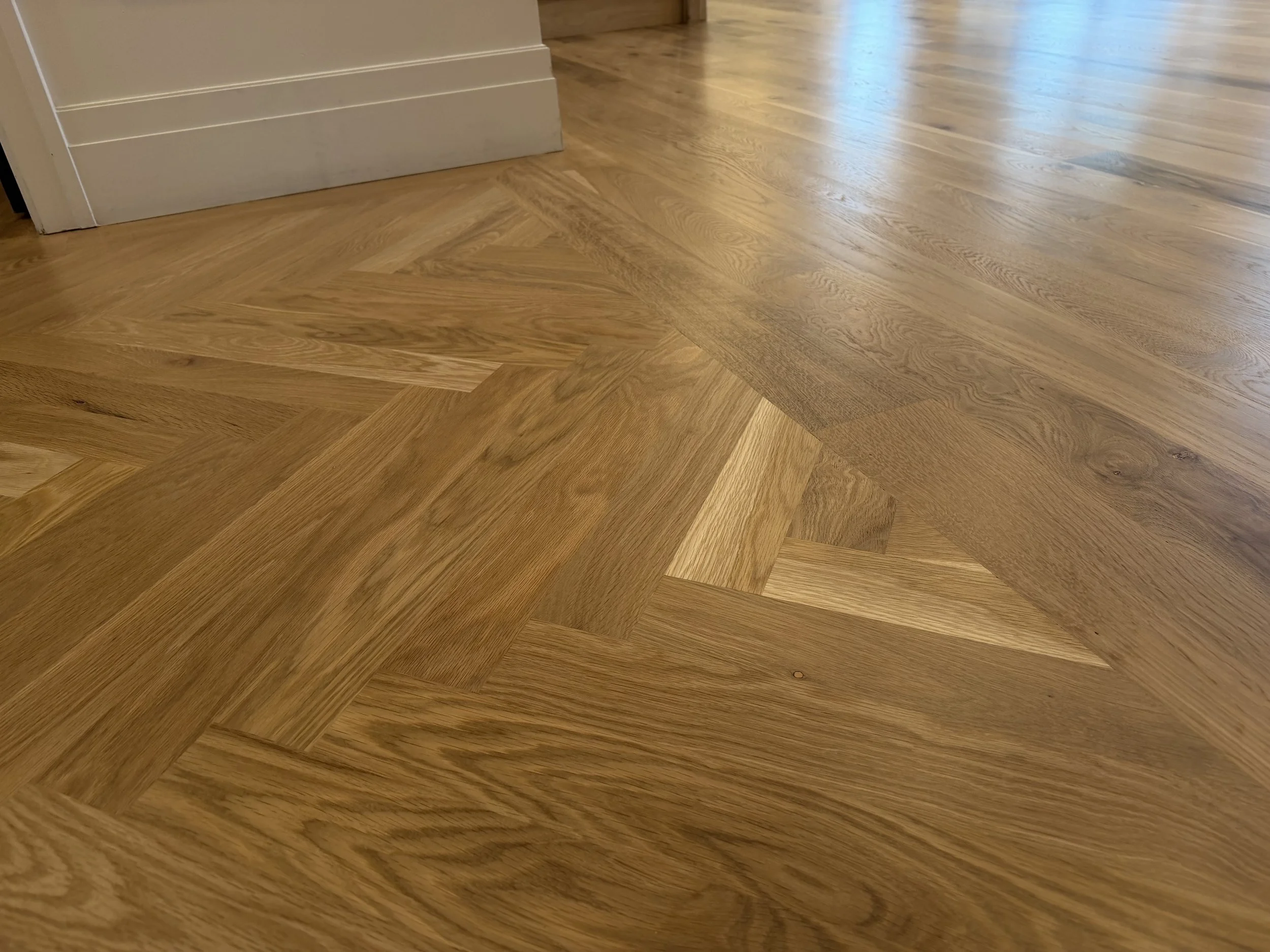
Click on the image to view the hardwood floor gallery. Refinished white oak herringbone hardwood | January 2026
Back to hardwood, if the floor has reached the end of its life cycle and can no longer be sanded down, there are other uses for that floor. In certain cases, the wood can be used to build other items. For instance, since most hardwood floors have a tongue and groove to connect to one another and will eventually become exposed given enough time and refinishes (thus denoting the end of its lifecycle), the back of the plank can still be in a prime position, depending on the subfloor quality and its ability to perform its job. The material could be used in other wood creations and often end up being used for home decor and even industrial pallet use. Even if the wood plank cannot be used as is, the material can still be recycled to be used in other products, like plywood or even WPC vinyl planks. The wood could also be burned to provide warmth or fuel, and in the worst case scenario, the wood is thrown out into a landfill and naturally decomposes to provide resources for the ground or other creatures in the area, unlike synthetic counterparts (“Environmental Benefits”). Wood will never simply take up space and contribute to the concern around landfills and ocean dumps because the wood will simply be reclaimed by the Earth itself.
Though we have not truly touched on softwoods in this article, the concept will, of course, still apply. Softwoods are highly sustainable options, like their hard species counterparts; however, softwoods typically only have 3 to 6 refinishes in their lifecycle because of their lower resistance to scratching. A softwood's durability is naturally lower than a hardwood and will therefore have a smaller lifecycle, but the material can still be reused in certain situations, burned, or decomposed. Arguably, they are less sustainable than hardwood species because they will likely need replacement sooner, but in the grand scheme of flooring options, softwoods are still highly sustainable and eco-friendly.
Final Thoughts
And there we have it: the sustainability of traditional site-finished hardwood flooring! There are so many factors that go into the sustainability of a flooring product, and hardwood flooring, despite the number of points we had to cover, is likely going to be the easiest article to write because of its origins rooted in nature. Hardwood flooring is the most sustainable option, especially when searching for sustainable and ethical timber mills, with its engineered variety and possibly wool carpet coming up right behind–though we will see soon enough.
References
“Environmental Benefits.” National Wood Flooring Association | NWFA, woodfloors.org/environmental-benefits/.
“Environmental Product Declarations (EPD) | NWFA.” NWFA | National Wood Flooring Association, 27 Mar. 2024, nwfa.org/environmental-product-declarations/.
Le Quéré, C., A. K. Jain, M. R. Raupach, J. Schwinger, S. Sitch, B. D. Stocker, N. Viovy, S. Zaehle, C. Huntingford, P. Friedlingstein, R. J. Andres, T. Boden, C. Jourdain, T. Conway, R. A. Houghton, J. I. House, G. Marland, G. P. Peters, G. Van Der Werf, A. Ahlström, R. M. Andrew, L. Bopp, J. G. Canadell, E. Kato, P. Ciais, S. C. Doney, C. Enright, N. Zeng, R. F. Keeling, K. Klein Goldewijk, S. Levis, P. Levy, M. Lomas, and B. Poulter. "The global carbon budget 1959–2011." Earth System Science Data Discussions 5, no. 2 (2012): 1107-1157.
Mackenzie, Jillian , and Melissa Denchak. “Deforestation and Forest Degradation: The Causes, Effects, and Solutions.” Nrdc.org, NRDC, 25 Nov. 2024, www.nrdc.org/stories/deforestation-forest-degradation-causes-effects-solutions.
Safety Data Sheet Acc. To OSHA HCS. LOBA, 20 Sept. 2021, www.loba.de/fileadmin/LobaDownloadsSchiffl/10020/us/SDB_US_10020_Universal_FloorCleaner_Concentrate.pdf.
“Stains & Penetrating Oils.” Bona, Bona US, 2021, www.bona.com/en-us/professional/wood-flooring-contractor/stains-and-penetrating-oils/.
“Sustainability.” LOBA, Loba-Wakol, LLC, 2026, www.loba.de/us_en/about-us/sustainability.
“Timbering Can Actually Help Wildlife - When Done Right | Catawba Lands Conservancy.” Catawba Lands Conservancy, 3 July 2024, catawbalands.org/timbering-can-actually-help-wildlife-when-done-right/.