
Learning the Art of Bonsai: Common Carpet Fiber Types

Save me for later!
When it comes to flooring, the options can sometimes feel like they keep coming along no matter where you look. There’s LVP, which alone has dozens of ways to mix and match different core materials and installation methods. Hardwood can come in different flavors as well, from engineered to prefinished engineered to standard hardwood and even prefinished standard hardwood—and that’s without even diving into the hundreds of wood species to choose from and the endless stain color combinations. Laminate and linoleum. Sheet vinyl. Tile and stone. We could go on and on about the different flooring options available for homeowners to select from, but today, we want to focus on one: carpet.
Much like other options, carpet has various options to mix and match various characteristics. Perhaps a polyester that is solution dyed will fit your needs. Maybe you want to try out a wool and nylon blend. Cotton also feels really nice to step on. To keep things simple, we are going to look at three of the most common fiber types: polyester, nylon, and wool. In the future, we will dive into other common fiber types, like Triexta (SmartStrand), polypropylene (olefin), and cotton, but these can be viewed as branches off of the other three categories or are more brand-specific at the moment.
Polyester
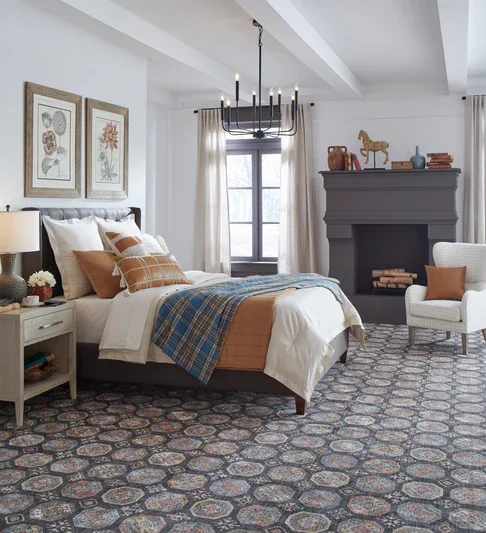
Image: Masland’s Scotland in Midnight. Click the image to visit the manufacturer’s webpage.
Out of our three carpet types, polyester (or also known as PET) is, on average, the most budget-friendly option. Polyester is a synthetic material, and for a majority of the PETs on the market, they are made with recycled materials. For that reason, carpet can actually be more eco-friendly than other synthetic flooring options on the market. Some carpet manufacturers pull waste from oceans and beaches to create their carpet, which results in a healthier environment for us, other animals, and the globe itself. Though this does not account for the actual manufacturing process, the fact that most polyesters are giving life to plastics in other ways instead of letting it deteriorate and cause harm elsewhere is a huge step in eco-consciousness.
Furthermore, because of the recycled and synthetic nature of polyester, prices per square yard are usually around $8-$30, with some options dropping much lower or higher than the given range. Differences within this price point often comes from the ounce weight, dye method, and other unique construction characteristics for each carpet, with some having features that make polyester more durable and soft than others.
Speaking of softness, polyester fabrics tend to have a softer feel because durability is not the priority. There are nylons, for instance, that do have an ultra-soft and fluffy underfoot, but polyesters are more likely to have that characteristic across the board, regardless of the carpet. Of course, that is not always the case, but that can be a fairly common benefit to polyester carpets.
The materials used to create polyester are also hydrophobic, meaning the fibers themselves are more likely to repel liquids and more importantly, the stains a liquid can leave behind. For instance, spilling a common staining agent like red wine may not leave as deep or noticeable stain compared to the same red wine spilling on other fibers like wool—for as long as the stain as attended to immediately upon happening. The wine is simply repelled and will find a harder time trying to soak into the fibers, though that does not mean the fibers are stain-proof. If saturated for too long and if the fibers do not have addition protections like being solution dyed, polyester can still stain. More on what other unique protections like solution dyed in future articles.
However, because polyester often serving as the most budget-friendly option, there is a cost that comes along with the lower price-point. On average, polyesters do not have the same durability characteristics other fibers often naturally have and are therefore more likely to experience and show wear-and-tear over time. Most polyesters do not have a defense against crushing and matting, meaning that, for example, if furniture is placed on a polyester carpet, once moved, the carpet will not be able to recover and bounce back to the uniform upright position. Sometimes, homeowners may be able to bring the fibers back to their standard position, but more often than not, the fibers themselves are still damage and will not be as durable or presentable as before. This is where other fibers like Nylon or sometimes Triexta can come into play, where durability and longevity are more important and pressing.
A good rule of thumb for polyester to tell if it is a high grade polyester is to rub your hand through the fibers. The higher-grade polyesters will feel more like a natural fiber instead of the plastic that it truly is. If the carpet is making any kind of sound that is reminiscent of plastic whatsoever, the carpet is likely going to be a lower-grade option. Visibly, the color should be consistent across the whole carpet or carpet sample. Finally, high quality polyester carpet brands often have either their company-specific branded polyester blend, such as Tarkett’s Cloud9, or other information about their polyester; if the vendor is hiding information about what their polyester is, then it could be an indication of a lower quality polyester.
Overall, if you are more worried about stain resistance than wear-and-tear, polyester carpet might be the direction you want to go in. There are high quality nylons in the market that will have a similar, if not the same or better, stain resistance than polyester on average—which gives you the benefit of both worlds—but those options tend to cost a lot more than your average to high-grade polyesters. In this case, where there is a greater concern for budget and stain resistance compared to wear-durability, installing polyester in low-to-mid-range foot traffic areas and picking a high grade polyester for high foot traffic areas instead can make the best of both worlds. For instance, install polyester in every bedroom and living room of the house, with nylon installed on the stairs. Polyester could also be installed on the stairs without concern, but you are going to want to find something that is looped, low pile height, and extremely tight. For more information on identifying carpet durability regardless of carpet fiber and dye methods, check out the blog post “How to Pick the Right Carpet Based on Weight and Pile”.
Nylon

Fabrica’s BRUSHstrokes in Titanium White. Click on the image to go to the manufacturer’s webpage.
Nylon is the highest grade synthetic material on the market in nearly every category—if not all. Carpets made with nylon fibers typically have the highest strength, resilience, versatility, and memory rating compared to other synthetic options like polyester. However, once again, this does not mean all nylons are created equal and should be automatically viewed as the superior option to polyester. Luxury brands such as Masland, Fabrica, Anderson Tuftex, and Stanton have nylons that will more than likely always outperform the highest grade polyester in nearly every category, but there are other nylons on the market that will struggle to compete with high-end polyesters that are given an extra boost in areas where polyester tends to perform worse. Rule of thumb: low-grade nylons are less likely to outperform a high grade polyester.
To tell if a nylon is a low grade nylon, there are a couple of tests you can do to a sample.
1- When you are looking at the sample and the fibers are all facing the same direction, is the sheen even? If the sheen is splotchy, the carpet is likely going to be a low-grade nylon.
2- If you gently separate the fibers, can you see the backing? The density of the carpet likely is going to be rather low, which in turn lowers the durability. The more fibers, and therefore the harder it is to see the backing, the stronger the carpet will be naturally, regardless of what the fibers actually are. The same concept can be applied to any carpet, no matter the fiber type.
3- Either by looking for information on the sample (or the manufacturer's website for the sample) or by counting multiple individual strands, you can find the twist count for non-looped carpets. (Looped carpets will be more durable.) If the twist count is 5 or greater, the durability will increase.
4- When looking at the backing of the carpet, is the backing tightly woven, securely bonded together, firm yet flexible enough to install with creating creases? Or, is the backing flimsy, prone to separating, and brittle? If the backing is the former, the nylon is going to be a high-grade, and if it is the later, the nylon is going to be low-grade.
5- Take the time to step on the carpet, without any type of pad underneath. Does the underfoot of the sample feel thin? If so, the carpet is likely going to be a low-grade nylon.
6- Immediately after stepping off the carpet, do the fibers bounce back to an upright position or do they stay crushed? If the fibers do not bounce back, the memory of the nylon is poor quality, meaning the carpet is likely going to be a low-grade carpet.
There are more methods of finding out whether or not a carpet is a low or high grade nylon, but these are ones that can easily be done to a sample without causing damage. For instance, a burn method does exist for nylon, which can be indicative of the nylon grade or type, but this is not usually possible to do at a flooring retailer or to their samples. Some carpet vendors do offer bigger samples to homeowners, in which case you can do the burn test on your own piece. However, be cautious of the fumes and other harmful chemicals that can be released burning the material.
Moving onwards, if you are looking at a high grade nylon, there are a couple of characteristics you may have noticed while doing the tests. Nylon fibers have what is called “memory”, which means they they will be able to bounce back to their standard position after being crushed, matted, or put through other forms of wear-and-tear. Years after installation, high grade nylon will still bounce back and look good-as-new, even after having heavy furniture placed on it. Memory may naturally fade over time due to age and wear, but signs of wear or damage will appear significantly later than a high grade polyester.
Nylon fibers are also more absorbent than other synthetic options, which can serve as a benefit and a detriment. The fiber’s absorbent nature allows it to take onto color rather well and will be able to hold onto that color throughout its life. This is why there are usually so many more color options than most polyesters. Venders like Anderson Tuftex and Fabrica are also able to do custom color options for their nylon products for this exact reason—nylon simply grabs onto color and will hold onto it for life. Removing the color will take more effort than other options, even if the nylon itself is not solution-dyed; color fading is therefore less of a concern.
However, that also means, if the nylon is not treated properly during the manufacturing process, the fibers are also extremely prone to staining. There are chemical coatings or additives manufacturers can add to the nylon to help make it more stain resistant and be on par to polyester. However, much like polyester, that does not mean the carpet is invincible to staining. If not treated properly and promptly, the stain can set and will prove more difficult to remove.
Solution-dyed nylons can also help fight against the staining issue, which allows the dyed-color (not the stain) penetrate all the way through the fiber itself instead of coating the visuals of the fiber. Most name brand and high end polyesters are solution-dyed, but there are not a lot of nylons that offer the same method. For a lot of nylons, depending on the dyeing process, the color itself sits on the outside of the fiber. Solution-dyed nylons are relatively rare in comparison to polyester carpets because the dyeing method costs significantly more than simply creating nylon and is more dangerous for the individuals creating and dyeing the nylon themselves. Nylon is created through a melting process, and to be solution dyed, the melting process can reach even higher temperatures. The machinery to solution-dye nylons costs significantly more, which means seeing this type of nylon will be a rare occurrence and will cost more. If the cost fits within your budget and is something you are willing to pay for, having a solution-dyed nylon is a rather smart investment, as stains will be easier to remove from the carpet itself without removing the original color of the carpet. The benefit itself is worth the extra cost, but that extra cost can be hefty and not feasible for most homeowners. High-grade nylon already has defenses against staining and can hold onto color well, so upgrading to a solution-dyed option is not necessary.
Wool
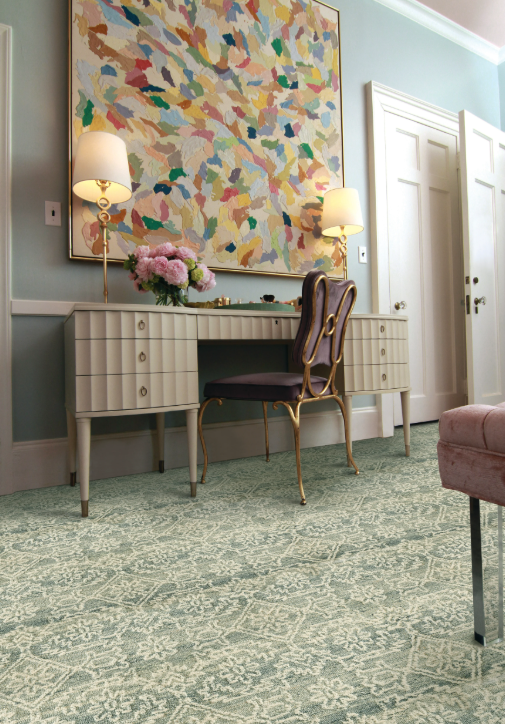
Image: Rosecore’s Grandeur Lace in Ocean. Click on the image to visit the manufacturer’s webpage.
Finally, we come to wool—the most luxurious and usually the higher priced option out of the three. If you have the budget for wool, the price is well-worth the upgrade for so many reasons. Wool is arguably the gold standard of carpet, and synthetic options have been trying to emulate the qualities of wool for decades; yet, nothing has quite come close to wool.
For starters, wool is a natural and easily renewable fiber. Out of the three, wool is by far the most eco-friendly option for the earth and for you. No fear over microplastics absorbing into your skin. No fear over how large of an effect does wool have on the environment. No fear over what will happen to wool after it has lived its life and needs disposed.
Furthermore, wool has a high moisture absorption rate and thermal regulation. The fiber has the natural ability to absorb moisture, both in the air and elsewhere, because the fiber is hydrophilic (water-loving). Wool actually has the ability to hold up to 35% of its own weight in moisture before becoming wet, meaning wool can naturally maintain an equilibrium of humidity within a home without putting other absorbent materials, like wood, at risk; if humidity rises, the wool will absorb the excess, and if humidity drops, the wool can release what it has absorbed. The same concept works with heat, which is why wool blankets work rather well in the winter and in the summer. For those with humidity fluctuations and drastic temperature changes throughout the seasons, wool can be a massive solution to the overarching problem without having to invest in a humidifier, dehumidifier, or other HVAC systems. Heafty cost upfront can actually lower your power and gas bill over time, thanks to wool.
Much like other textiles—synthetic or natural—wool has the ability to absorb air pollutants. However, wool’s natural properties allow it to absorb more pollutants at a faster rate for a longer period of time. In a research study performed by AgResearch scientists in New Zealand, they discovered that “wool carpet can reduce high levels of introduced formaldehyde to virtually zero in 4 hours… Similar results were achieved with nitrogen dioxide, although the absorption rate was slower” (“Breathe Easy”). Contrasting wool to another high-end fiber, nylon, the same study found nylon could also absorb the same gases, but they did so at a slower rate and therefore had a higher concentration of the gases within the same time frame. Furthermore, wool has been estimated to continue purifying the air for up to 30 years (“Purifies Your Home”). Healthier air in a space you want to feel safe and cozy can help one’s health compared to an environment with pollutants that end up attacking the body. In addition, for those that struggle with allergies, wool can help remedy your respiratory issues. Other carpets will hold onto the dust and other airborne allergenics or pollutants, but wool will continue to clean the air. Just remember to maintain the carpet and vacuum at least once a week to help give that extra boost of clean air!
Wool is also innately fire resistant and has proved to outperform all other common carpet fibers, simply because of the wool’s high nitrogen and water content (Looks like the ability to absorb 35% of its weight in moisture without becoming wet has also flame resistance!). Because of this, wool takes a higher temperature to ignite, and when it does, it will not melt unlike its synthetic counterparts and will instead create an insulating char. The water itself allows the wool to be self-extinguishing, a slow release of heat, and will produce less smoke or other toxic gases compared to its synthetic counterparts.
Ultimately, these handful of properties come from wool’s natural defense for sheep, allowing their coat to absorb moisture to keep them temperature-regulated and clean. From a health and safety perspective, wool will always outperform any other synthetic material and arguably other natural fibers like cotton.
In terms of staining, wool is naturally coated in lanolin, which causes water to bead up when it comes into contact onto the wool’s surface. However, like any other textile, if the stain sits on wool for too long, the carpet will be stained. Furthermore, if the stain is one that is meant to change color, like dyes and bleach, wool is not resistant to facing damage. Since most stains are water based, the wool will be able to fight against the stain well, and the fibers can be easily cleaned if the spill is taken care of promptly.
The fibers are also naturally have a coil shape, which is rather similar to the high-twist and loop nature other carpet fibers can be woven into. As such, without much extra guidance, wool will be more durable for the same reason high-twist and looped carpet are viewed as highly durable options.
However, when it comes to maintenance, homeowners will need to be cautious because any use of harsh chemicals or a harsh beater bar within their vacuum will likely cause permenant damage to the fibers; wool is like our hair, in this manner, after all. When a wool carpet starts to shed, this is often a symptom of a harsh beater bar and improper cleaning. The routine annual deep cleaning also needs to be performed by a professional, as most homeowner accessible equipment, such as a Rug Doctor, will be too harsh on the wool fibers. For vacuum and cleaning guidance, visit woolsafe.org for more information.
As for what is the best option out of the three, it truthfully comes down to your budget and needs. From a benefit perspective, wool would probably be the best option, but that isn’t feasible because of the maintenance differences for wool carpets versus synthetic fibers—and not to mention the cost differences. Nylon is also a high-end choice that will perform rather similar to wool’s durability, simply without the added natural benefits of wool, but sometimes the cost is too high. There are luxury, budget friendly nylons on the market, such as Masland’s MZ series, but not everyone wants or needs the benefits of nylon. Sometimes the soft, fluffy nature of polyesters is what a homeowner actually wants, so why try to find a fiber type that just doesn’t always offer what you are looking for?
There we have it: the three most common carpet fiber types! Check out last week’s article on picking the right carpet based on a carpet’s face weight and pile height! Together, these two articles can help steer you in the right direction for all of your carpet needs. For next week’s article, we are going to focus on dyeing methods and what methods you should keep an eye out for when selecting your carpet.
Want information on a different carpet fiber or have another carpet question? Contact us by clicking here!