
Nurturing a Greener Future: The Sustainability of Luxury Vinyl Planks (LVP)

Save this post for later!
In our last sustainability post, we went over traditional site-finished solid hardwood and the different ways to look at the environmental impact of hardwood flooring. You can find that here. This week, we are going to dive into one of the most popular, if not the most popular, flooring type on the market right now: Luxury Vinyl Planks, or better known as LVP. LVP is a synthetic plastic based planked flooring option that is designed to resemble either a hardwood, stone, or tile look, offering waterproofing benefits and budget friendly options. There are multiple types of LVP, such as Wood-Plastic Composite (WPC) and Stone-Plastic Composite (SPC), with differing types of installation methods, but to keep things simple for our discussion today, we are going to use the umbrella term of LVP to cover all forms. In future blog posts, we can dig deeper into the different types of LVP to see which options are more sustainable than others and why, but having information about the LVP industry as a whole will make for a strong foundation for those discussions.
A final note before diving into our LVP discussion, we have a glossary with the most common terms related to this type of planked flooring. If there are terms you are unfamiliar with while reading this blog post and it is not defined, there is a chance that word is in the glossary for reference. Click here to open a seperate tab to the glossary post for reference if needed.
Beginning of the Manufacturing Line
To capture a full picture of the environmental impact of LVP, we are going to start at the beginning, where the materials themselves are mined. We are going to assume LVP is manufactured using virgin materials, meaning pure, unmixed materials, that have never been used before; that is to say, materials that have only recently seen sunlight after spending thousands to millions of years underground and have never been used in a man-made product before. There are products on the market that use or claim to use recycled material, but these products can be difficult to find in the first place. As such, the discussion will be more valuable in providing information if we assume the most common practice, which is virgin, nonrecycled material.
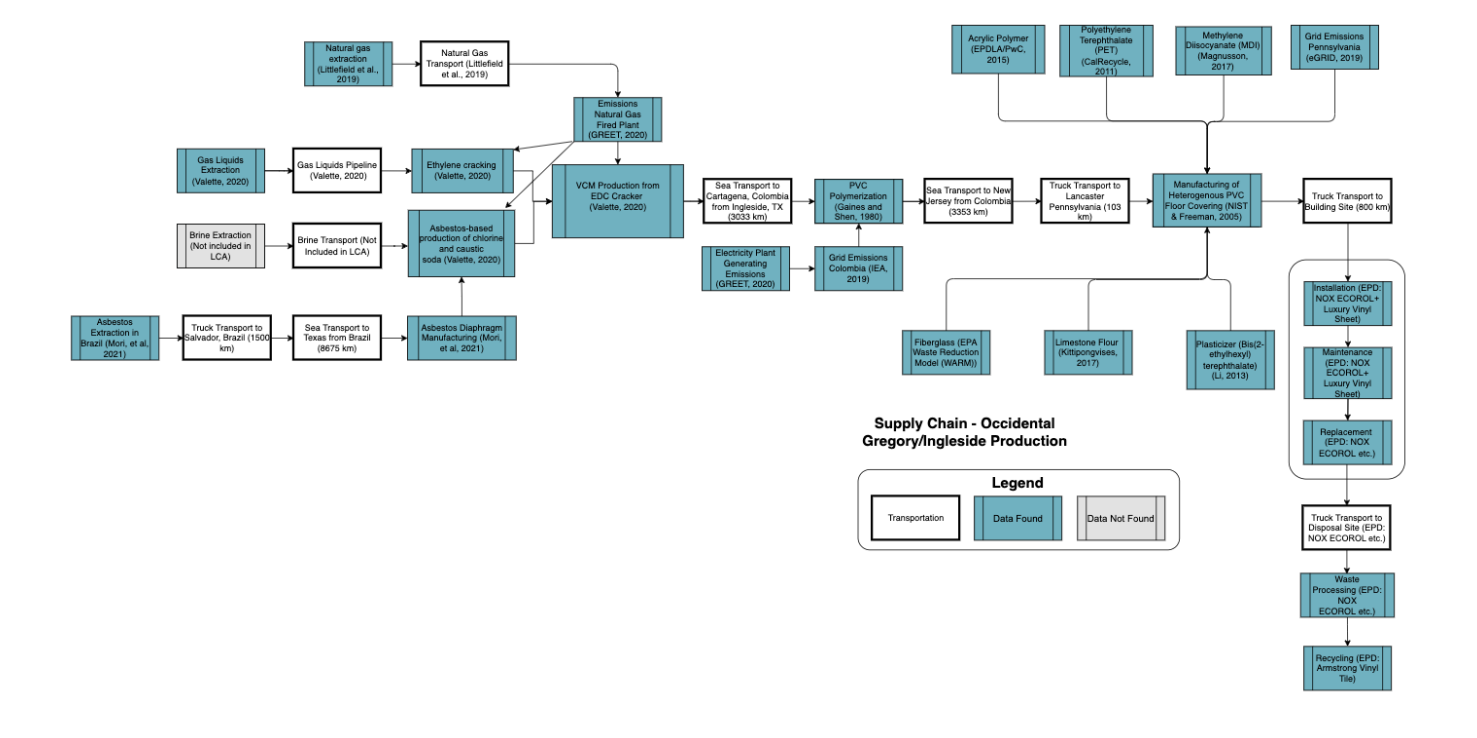
The Ingleside, Texas Supply Chain Production diagram for LVP (PVC flooring). For all LVP products manufactured in the USA, the supply chain will look rather similar to this diagram. For more information on this diagram, visit the Center for Environmental Health or by clicking the image for a direct link to the source used (CEH Figure A2).
Above is a supply and manufacturing chain for a specific LVP product created in the United States. Naturally, this supply chain will look different for 100% imported products and other regions of the world, but I think this specific model will suffice for our discussion. Furthermore, this diagram also shows the lifecycle of an LVP flooring, all the way down to its removal and either its final resting place in a landfill or in a recycling center. Having that final portion outlined will be handy in the final portion of our discussion. With that said, let’s focus on around the first third of the supply chain, which will include everything up to the box titled “VCM Production from EDC Cracker”.
Material Gathering
We should probably tackle the elephant in the room first, and that’s asbestos. One of the first steps in creating an LVP plank is mining for asbestos. Deliberately. In our world today, that feels absolutely absurd! We know asbestos is a horrible substance that can cause numerous cancers and other massive health risks for those that come in contact with the substance, so why are we still using it?
To help explain the use of asbestos, let’s jump a tiny bit ahead in the manufacturing process to the creation of PVC. PVC is the abbreviated term for polyvinyl chloride, otherwise colloquially known as vinyl. Since the product is a chloride, without knowing much more about the product, we can deduct that PVC is produced with the element, Chlorine. There are multiple methods to produce chlorine, and all of which typically fall under the “chloralkali process”, which is the process of using electrical charges, better known as electrolysis, to cause a reaction with the compound, sodium chloride (NaCl) or better known as table salt. Let’s focus on the chloralkali process portion of the creation of PVC, as this is where asbestos can come into play.
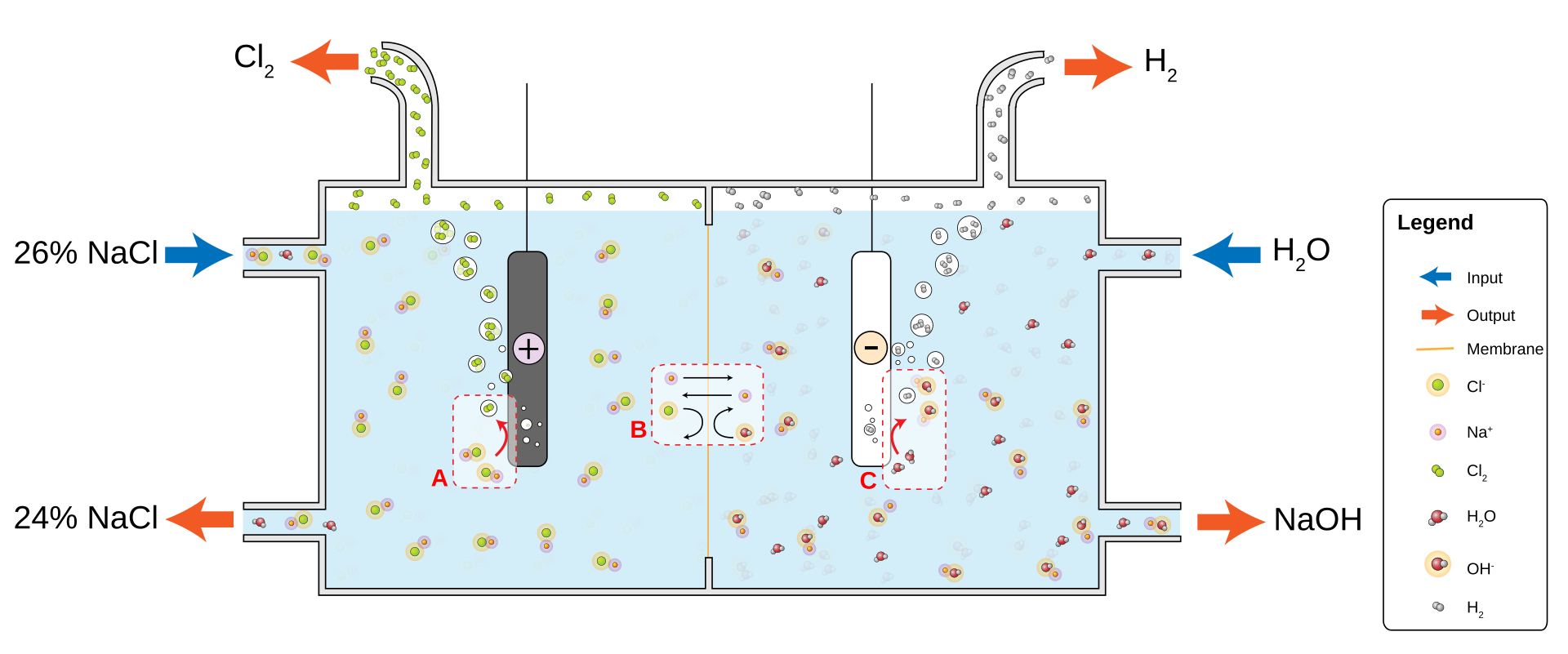
Diagram of the chloralkali process, created by Wikipedia user Jkwchui. *See Footnote below for credits to the inspiring study. Click on the image to go to the original site.
Regardless of what method of chloralkali a manufacturer uses, all use a similar method that separates salt through the use of electricity in a water solution, with a majority of methods using a membrane separating the solutions from other chambers. This section will go over a basic method that includes a membrane, as the membrane is relevant to our discussion of LVP.
For starters. NaCl is made of the elements Sodium and Chlorine, with the former a metal and the later a gas. Both elements are rather reactive due to the electron count, which is can be found by their location on the Periodic Table of Elements. Chlorine, in particular, is a halogen, and these gases are one electron short of having a complete set of valence electrons, the electrons located on the outermost shell of an atom in the electron cloud. Because of this, halogen gases are going to want to bond with something to meet the desired 8 valence electrons; Sodium has one valence electron on its third energy shell, so it is going to want to get rid of the single electron to have a complete electrical set. As such, when these two elements meet, they are going to want to create what is known as an ionic bond, where they will share Sodium’s extra electron. Electrons are negatively charged, so Chlorine therefore becomes negatively charged (known as the electrolyte chloride) and Sodium will become positively charged. An important note, the two elements undergo a redox reaction, where Sodium oxidizes and loses an electron and Chlorine reduces and gains an electron.
Going back to the chloralkali process, the processes uses a salt water mixture (a brine) and the brine is moved through a chamber. An ion-selective membrane separates this chamber from another, which has clear water running through it. Inside of the brine chamber, there is an anode, where an electrical current passes through a metal pole and thus causes oxidation, where the Chloride part of NaCl oxidizes and becomes chlorine. The sodium (Na) is now able to freely move across the membrane because it still has a positive charge, whereas the oxidized chlorine is negatively charged on its own and therefore cannot pass through the membrane. Sodium is now flowing through clear water as it emerges from the membrane, but this time, there is a negatively charged pole, known as a cathode in the chloralkali process.
Water is inherently without a net charge, but because of the way hydrogen and oxygen are sharing electrons, water molecules do have a polar charge, where the hydrogen atoms have a slight positive charge and the oxygen atom has a slight negative charge. Because of the slight difference in charges from one end to another, the slightly positively charged hydrogen ions are attracted to the negatively charged cathode; the water will therefore reduce to hydroxide and hydrogen gas. Hydrogen gas will be able to leave the chamber, whereas the hydroxide, the singular hydrogen and oxygen atom pair, is left and now at a net negative charge with the extra electron. The sodium that has now entered the chamber will see the negatively charged molecules and will want to bond with them, thus creating NaOH, sodium hydroxide or otherwise known as lye, which can be used in the plastics, textiles, and cleaning manufacturing sectors.

Pictured is Chrysotile Asbestos. Image provided by Wikimedia Author James St. John. Click here for licensing information.
The process itself can be rather safe, but the danger lies in the membrane material. In most cases in the modern world, the membrane is usually made of Nafion, Flemion, or Aciplex, which are synthetic membranes made of vinyl or other materials that are chemically and mechanically stable, even in harsh conditions.
However, these membranes have not always existed. Some methods use asbestos fibers to create the membrane, whereas others use mercury—both of which can be highly dangerous to a person if exposed. Though society has since discovered safer alternatives, asbestos in particular can still be used to separate chlorine from salt in plastic production. In our LVP supply chain above, factories producing plastic materials in the United States still use asbestos because certain asbestos fibers mined in Brazil are still permitted for manufacturing use in the United States and other nations such as China. (Interestingly enough, Brazil has banned the use of asbestos but continues to mine it as an export only.)
With that in mind, we find it important to mention not all LVP has a portion during the supply chain where asbestos is used. There are vendors that use more ethical means of production, which means safer alternatives are used—however, that is not to say the entire method is safe, only that some select plastics that have not been in contact with asbestos at all. There are trace amounts of asbestos, or mercury, in some products—which in and of itself can be highly dangerous—but it’s the fact that asbestos is still being used and consequentially putting the lives of many at risk, including but not limited to the miners, factory works, and those living in villages and towns surrounding the mines and factories. Ignoring the direct environmental impact of mining and manufacturing, generations of human lives are being put at risk and even more so if asbestos is involved.
PVC
For the sake of simplicity, we will not dive deeper in the actual manufacturing of PVC but instead focus on the movement of the products. The asbestos, as mentioned before, is mined in Brazil (Specifically, Salvador, Brazil), so the material must be driven to a port then shipped overseas to the first stop: Ingleside, Texas, United States. Figure A2 Supply Chain report we are examining does not include the brine extraction process, but we do know the natural gas used to create the PVC, as well as power the factories themselves, is domestic United States-side. In Ingleside, Texas, the chloralkine process happens, then the resulting chlorine is cracked alongside natural gas to create the next compound, vinyl-chloride monomer (VMC). These are the final molecules to make PVC and what we know as plastics.
The VMCs are then transported from Ingleside, Texas to Cartagena, Colombia, where the final stages of PVC are completed. Here, the VCMs are polymerized, meaning the VCMs are melted down into a liquid form and are suspended in water, which causes the molecules to bind to one another (Polymers, after all, are just a large chain of molecules, or monomers that can react with other monomers, to make an even bigger structure.). Now that we have PVC, we can use it to make LVP flooring, which means the materials are ready to be shipped again, this time to a port in New Jersey.
We will pause here on the chart once again to discuss. From this point, the materials come from an origin country (In this case, the asbestos comes from Brazil and will therefore serve as our furthest origin country that we have listed in CEH’s PVC report.), and they are sent to Ingleside, Texas to separate the atoms into individual parts via truck and sea. After the materials are separated into key parts and then rebonded using natural gas, they are shipped once more to Cartagena, Colombia by sea. The Colombian factory then polymerizes the materials produces at the Texan factory, and they are sent off by sea once again to New Jersey. That’s three separate one-way ocean liner trips, which is going to naturally use thousands upon thousands of gallons of fuel to run and will produce thousands upon thousands of pollutants into the air and sea. Though we won’t be diving into this specific supply chain later, we will be going into the tonnes of pollutants later on in the article that arise during the shipping within the supply chain.
LVP
Now that we are in New Jersey, we can move forward to our next destination, Lancaster, Pennsylvania, United States, where the PVC will be used to create the actual LVP planks; New Jersey is simply the port stop for the materials, meaning the materials will then be loaded onto trucks and shipped out to Pennsylvania for actual use. At the Pennsylvania facility, the LVP is mixed with other materials, such as limestone, that will stabilize the flooring planks. As such, another supply chain is created at this stage, as we need to account for any stones, fillers, and stabilizers used to create the planks; though the diagram does not dive into each specific material, it’s safe to assume, based on the studies done to follow each supply chain, the final diagram would be rather difficult to follow and would be overwhelming. As such, we won’t dive into them further, but for more information, visits the CEH’s PVC report to find the studies that explore the supply chain for each specific additional material used.
Once the planks have been made, they are boxed up—where the box itself will have its own manufacturing chain based on what type of cardboard used, where it came from, what dyes are used to print on the box, and so on. Usually, the manufacturer does not store the final product on-site, meaning they are typically transported to a warehouse (not shown on diagram.) From there, a consumer will purchase their flooring, and the boxes are typically sent to the flooring store itself via truck; the installers will then pick up the material and transport them one last time for installation. Because the flooring will end up at an unknown location at each step of the way post manufacturing, CEH consolidates the transport to a single, 800 km line, meaning the actual 800 km mentioned is a rough estimate or average of where the flooring could finally land.
Installation
The rest of the LVP’s life is fairly straight forward from this point on. The installer installers the floor, which can include VOCs and other gases that contribute to the overall eco-quality of the floor’s lifespan. The homeowner will assumably maintain the floor through weekly routine cleanings, meaning more VOCs, gases, and other chemicals (either natural or manufactured, does not mean dangerous). The floor will eventually wear-down after 20-50+ years, depending on the wear-and-tear the product can withstand and experiences, which means another supply chain will be inserted into the overall home’s lifetime supply chain to replace the existing floors. The old product will be removed and transported again to a waste processing facility, usually local, and will remain in the landfill; most LVP is not recycled and is rather difficult to recycle, so we will assume they will end in the landfill. In other words, once the floor is installed and has been given enough time to acclimate to its new home, the environmental impact of the floor will go down, as it is not directly contributing more to the world around us until it is time to remove.
Because LVP does not continue to majorly impact the environment once installed, the overall lifespan of LVP will appear to have a lower if we take the total ecological influences and average them out per year for every year installed. The only forms of ecological concerns to address is wet-mopping maintenance, where water is naturally consumed and cleaning products can potentially affect both the waste water and the durability of the floor. Since cleaning products differ in how much water it requires, as well as what the product is made out of, we are going to ignore diving into the cleaning portion of LVP’s sustainability; there are too many variables that can impact the sustainability of LVP in both positive and negative ways. As such, we can now move on to the second major point of interest in the ecological impact of LVP during its lifespan: the disposal period. Though microplastics will likely impact those walking on the LVP floor frequently, that can be and deserves its own discussion in a later blog post.
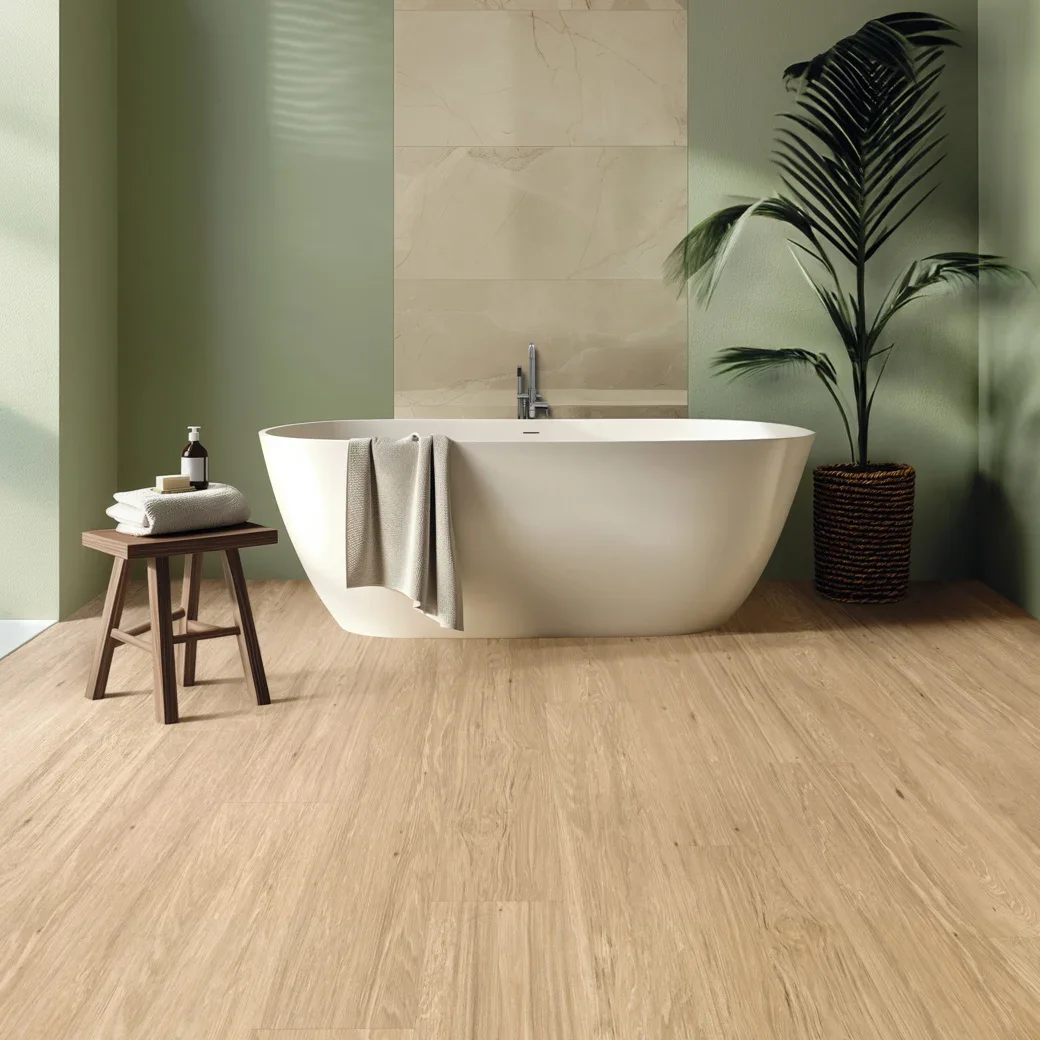
Karndean River Hickory RKP8250 from the Korlok Select collection. Click on the image to view the flooring on Karndean’s website.
Post Installation
LVP flooring, for the most part, is recyclable in theory, but not always in practice. Depending on the location of the product’s installation, there may not always be an easily-accessible facility that can take PVC-based products and reuse them. Therefore, most LVP ends up in the landfill and will take thousands of years to deteriorate and return to the Earth. However, recycling the product is possible, and with the help of certain manufactures, such as Karndean, recycling centers for LVP are starting to appear around the globe (“Global Environmental Statement” 3, 9). In other words, the flooring industry has seen and felt the environmental impact through protests, government restrictions, and other forms of pressure both inside and outside of the company. Continuing the fight of sustainability through protests, selecting which company to “invest in” by purchasing their products when needed, and other forms of petitioning against governments and companies is working and is making certain programs more accessible.
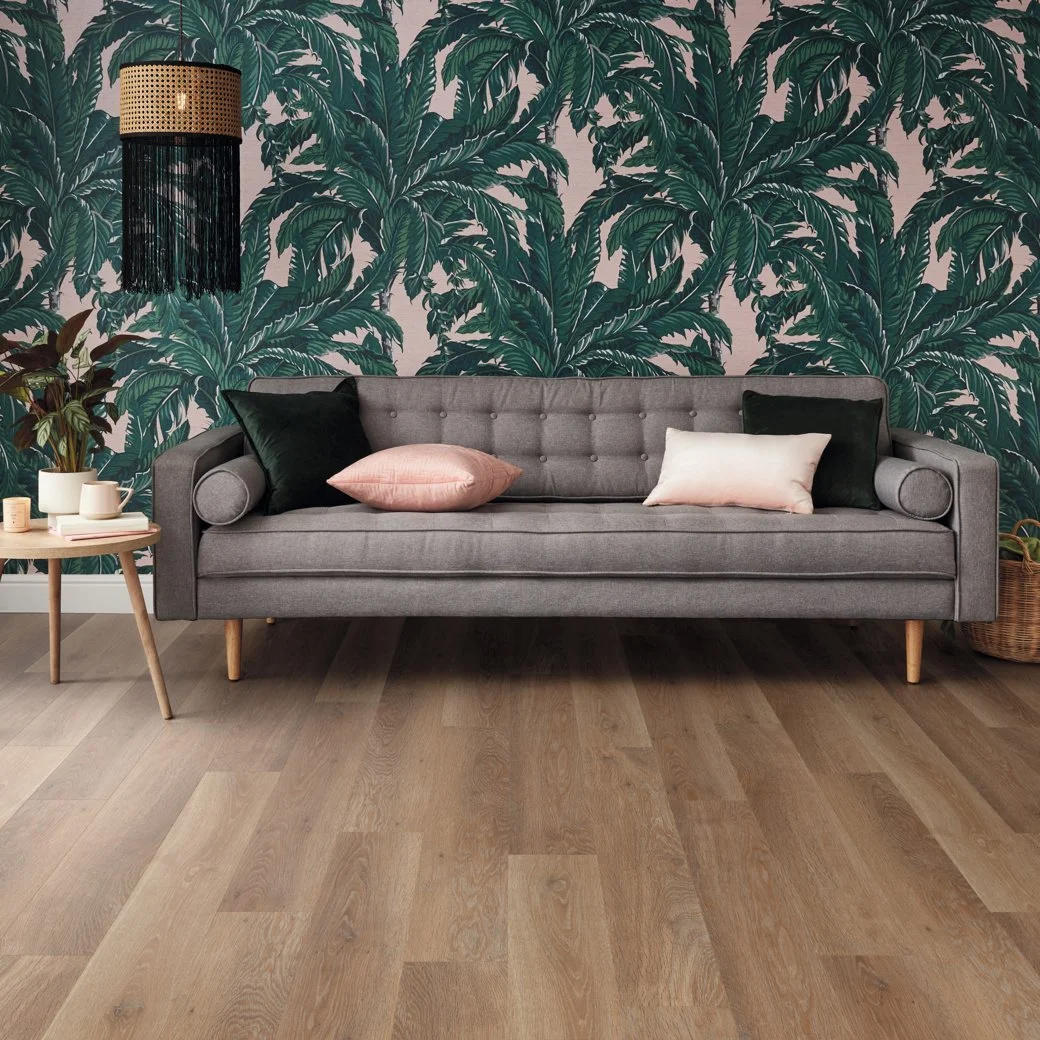
Karndean’s Pale Limed Oak KP94 from the Knight Tile collection pictured on the right. Click on the image to view the floor from their website.
Speaking of Karndean, the company also prioritizes the ability to reuse and reinstall their products—even their dry-set glue! Their loose lay products, for instance, can be ripped out and reinstalled in another area completely, for as long as the majority of the plank is still in useable conditions and not cracked or otherwise majorly damaged. Loose lay can also be re-trimmed down to the new size, meaning if the top inch of the plank is broken but the rest is otherwise in good condition, the top can be cut off and the plank can be reinstalled. The same concept goes for the glue-down product, and to some degree, their rigid core products. (Note, rigid core will need more care and attention when removing planks to ensure the locking mechanism doesn’t break. Broken locking mechanisms can make the plank no longer useable.) Karndean’s dry-set glue can also be reused in the same area if using a similar product as before. For most people, they may need to reinstall a plank after a flood. We’ve had to do this in our own office with Karndean’s products; our water heater started to leak, so we wanted to remove a couple of boards to check the damage done to the subfloor. We fixed the water heater, let the subfloor dry out, and relaid the planks. The glue took on the new planks well and did not need another fresh coat, but we decided to add a new coat regardless since we wanted an extra layer of subfloor protection just in case the water heater decided to have another fit—not for the plank itself.
Reusability could, arguably, be said about all LVP, where if the product is taken care of and removed with care, the floor can be reused. Happy Feet and Stanton’s Loose Lay boast these features naturally due to the installation capabilities. However, most companies do not design their products with reusability or sustainability in mind, meaning the product’s integrity may not be as strong when reused compared to a manufacturer who explicitly states products can be reused. If a product is designed to take massive wear-and-tear, while also promoting its reusability, then as far as LVP goes, the product is likely going to be more eco-friendly than other options. Finding company environmental statements usually is not too difficult to find online, but if you are struggling to find their statement, try reaching out to a local flooring store that offers that specific vendor’s product to see if they have access to it or can otherwise find it. We will compile environmental statements as we find them for all of our current flooring options, so sign up for our newsletter for update notifications by clicking on “newsletter” or scrolling down to the end of the blog post.
Final Notes
As a final note, we can see that LVP has a mixed sustainability when taking into account the entire lifespan of the material, from its time in the ground as oil to its time in the landfill. Certain vendors take sustainability more seriously than others, which can play a huge role in deciding what floors to go with if the environmental impact is something you are concerned with. Installation format can also play a bigger role, as seen with the gases it may off-put and if it can be reused again or not. However, LVP isn’t necessarily the worst flooring type to install for the Earth, as we will explore with other materials down the road. Remember, what you have installed currently is going to be the most sustainable option because that delays whatever the material is from entering the landfill and leeching forever chemicals into the ground; perhaps when it comes time to replace your LVP, recycling centers will be more accessible and efficient to process your old floors.
Works Cited
* Bommaraju, Tilak V.; Orosz, Paul J.; Sokol, Elizabeth A.(2007). "Brine Electrolysis." Electrochemistry Encyclopedia. Cleveland: Case Western Reserve University.MSN Encarta. "Chloralkali Electrolysis." Archived 2009-10-31, CC BY-SA 3.0, https://commons.wikimedia.org/w/index.php?curid=17868243
“Global Environmental Statement Karndean Designflooring and the Environment.” Karndean Design Flooring, 2018.
“Groundbreaking Report Reveals Vinyl Flooring’s “Dirty Climate Secret.”” Center for Environmental Health, ceh.org/flooringreport/.
Leiva, Jimena Diaz, et al. “Flooring’s DirtyClimate Secret Quantifying Carbon Dioxide Emissions and Toxic Chemicals Used in Vinyl Flooring Manufacturing.” Flooring’s DirtyClimate Secret Quantifying Carbon Dioxide Emissions and Toxic Chemicals Used in Vinyl Flooring Manufacturing, 19 May 2022. Center for Environmental Health, ceh.org/wp-content/uploads/2022/05/PVC-Report-5-5.pdf.
Maski. “[GRADE 12] Production of Chlorine through the Chlor-Alkali Process.” YouTube, 18 Nov. 2025, www.youtube.com/watch?v=OAm3-gRmNh4.